

What’s In This Guide
- How Do I Know If My Water Bill Increase Is a Leak?
- Rate Increase or Leak? A Side-by-Side Comparison
- Why Fulton County Water Bills Went Up in 2026
- Warning Signs of a Hidden Underground Water Leak
- How to Test Your Water Meter for a Leak
- What’s Behind Underground Leaks in Alpharetta Homes
- What Affects the Cost of Underground Leak Detection and Repair
- When to Call a Professional for Water Leak Detection
- Frequently Asked Questions
- Ready to Find Out What’s Really Behind Your Water Bill?
If your Alpharetta water bill jumped in 2026, the change could be driven by Fulton County’s 5% volumetric rate increase, higher seasonal usage, or a hidden underground leak on your property. A rate increase leads to higher charges for your existing usage tier, whereas a hidden leak causes continuous water loss that can drive your bill up sharply regardless of household habits.
If your usage has jumped unexpectedly without a change in household habits, searching for reliable leak detection companies near Alpharetta, GA, is the fastest way to pinpoint the problem before buried water line damage gets worse.
Quick Facts
- Fulton County’s 5% water and sewer volumetric rate increase took effect January 1, 2026, with a second 5% increase set for January 1, 2027.
- A rate increase raises the cost applied to your consumption tiers, while an undetected underground leak can increase your measured volume above normal usage.
- A moving meter dial during a two-hour no-water window is the clearest sign of a leak somewhere on the property.
- Soggy yard patches, sunken soil, or an unusually green strip of lawn can sometimes point to a buried water line leak.
- Persistent unexplained spikes call for professional leak detection before digging, since guessing at a repair location wastes time and money.
How Do I Know If My Water Bill Increase Is a Leak?
Start by checking whether the increase reflects Fulton County's published rate adjustment or higher measured usage. A rate increase raises the cost applied to your consumption tiers across the billing cycle.
A leak behaves differently. It can show up as a spike specific to your account, often with no change in how your household actually uses water. If your bill jumped well beyond what a 5% adjustment would explain, unexplained water use somewhere on the property may be contributing to the difference.
The fastest way to investigate is a simple meter test, covered in the step-by-step section below.
Rate Increase or Leak? A Side-by-Side Comparison
|
What You're Seeing |
Rate Increase |
Underground Water Leak |
|
Bill pattern |
Small, consistent rise across the whole bill |
Sudden spike, often well above prior months |
|
Meter behavior |
Dial stays still when no water is running |
Dial keeps moving during a no-use test |
|
Yard condition |
No visible change |
Wet spot, sunken area, or a noticeably greener strip of grass |
|
Indoor fixtures |
Working normally, usage feels unchanged |
Fixtures check out fine, yet the bill keeps climbing |
|
Timing |
Aligns with the county's new billing cycle |
Can appear at any time and often worsens gradually |
If most of your bill increase lines up with the rate increase column, the billing adjustment is likely the cause. If your account looks more like the underground water leak column, a leak is worth investigating.
Why Fulton County Water Bills Went Up in 2026

Fulton County's Board of Commissioners approved a 5% rate increase for water and sewer service, effective January 1, 2026, with a matching increase scheduled for January 1, 2027. The county implemented this adjustment to support operating and capital costs for the water and wastewater system.
The current schedule for Fulton County's water and sewer service charges shows the increase applying broadly across residential accounts, based on a tiered structure tied to consumption. That means the rate change alone should produce a modest, predictable shift in your bill, not a dramatic one.
A high water bill in Alpharetta that goes beyond what the rate change accounts for may indicate an underground issue, such as a buried main service line, an irrigation supply line, or a leaking fitting hidden beneath your yard.
Warning Signs of a Hidden Underground Water Leak
Underground leaks are quiet by nature. Water often disappears into soil before it ever reaches the surface, so the usual clues are indirect rather than obvious.
Watch for these indicators together, not just one in isolation:
- A bill that jumps well past what a 5% rate change would explain, especially if household habits haven't changed
- A soft, soggy, or unusually cool patch of yard that stays wet without rain
- A section of lawn that grows greener or faster than the rest of the property
- A hissing or trickling sound near the water meter when every fixture inside is off
- Cracks or shifting in a driveway, walkway, or foundation edge, which can follow sustained water saturation in the soil
According to EPA WaterSense data on residential water leaks, the average home wastes thousands of gallons a year from leaks, and roughly 1 in 10 homes has a leak significant enough to waste 90 gallons or more per day. Much of that reporting focuses on indoor fixtures like toilet flappers and faucets. If you've already checked those and found no issues, an underground leak along the main water service line running from the meter to the house is another possibility to consider.
How to Test Your Water Meter for a Leak
A DIY water meter leak test takes about two hours and requires no special tools beyond access to your water meter, usually located near the curb or property line.
Step 1: Turn Off Every Water Source
Shut off all faucets, appliances, irrigation zones, and anything else that uses water. Confirm ice makers and automatic sprinkler timers are also disabled for the test window.
Step 2: Record the Starting Meter Reading
Locate the meter box and note the exact reading. Most residential meters display a rotating dial or a digital leak indicator, sometimes a small triangle or star, that moves whenever any water flows through the line.
Step 3: Wait Without Using Water
Let two hours pass with no water use anywhere on the property. Avoid running the dishwasher, doing laundry, or flushing toilets during this window.
Step 4: Check the Meter Again
Return to the meter and compare the reading to your starting number. If the dial moved, or the leak indicator spun, water is passing through the line somewhere on your property even though nothing was turned on.
Step 5: Narrow Down the Location
If the indicator was moving but stopped when you shut off the main valve inside the home, the leak is likely on the house side. If it keeps moving with the main shutoff valve closed, the leak is probably in the water service line between the meter and the shutoff valve or in another branch supplied before that valve, which typically calls for professional leak detection equipment to locate without unnecessary digging.
READ MORE: Signs You Need Sewer Line Repair in Alpharetta, GA
What's Behind Underground Leaks in Alpharetta Homes
Alpharetta is located in Georgia's Piedmont region, where local soils can shift and settle over time due to moisture changes and environmental conditions. Ground movement can put stress on buried pipelines, particularly at joints, fittings, and older pipe sections with reduced flexibility.
Unlike a burst pipe that floods a basement, an underground leak can remain hidden as water seeps into the surrounding soil instead of pooling visibly. A small leak may worsen gradually, and an unexplained increase in water usage may be one of the early signs.
This is where underground plumbing work differs from a typical indoor repair. Locating a leak accurately before any digging starts protects landscaping, driveways, and hardscaping that would otherwise be disturbed by guesswork.
What Affects the Cost of Underground Leak Detection and Repair
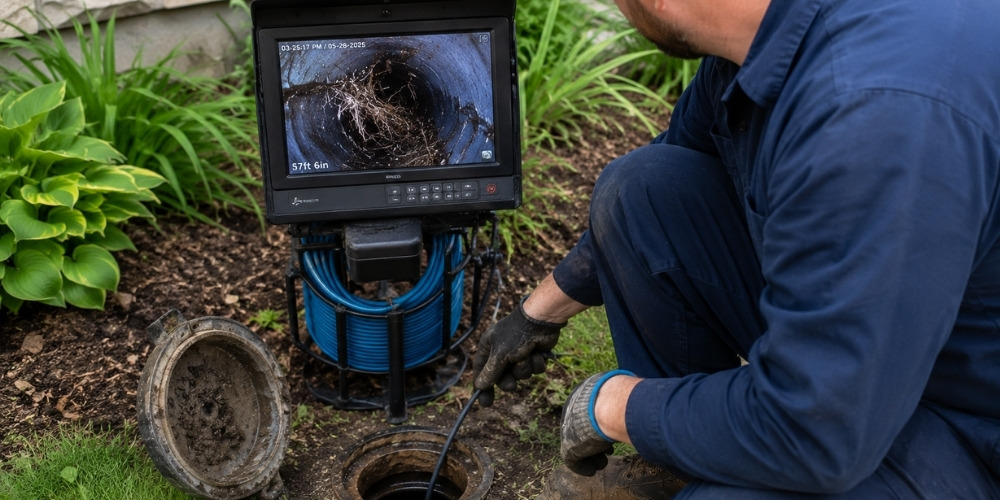
Leak detection and underground repair costs vary by project, so there isn’t a single number that applies to every home. Several factors typically shape the estimate:
- Leak location and depth, since deeper or harder-to-reach lines take more time to access
- Pipe material, as copper, PVC, and PEX each respond differently to repair methods
- Site conditions, including soil type, slope, and what’s planted or built above the line
- Access needs, such as whether trenchless methods can be used or open excavation is required
- Scope of damage, since a single fitting failure differs from a longer section of degraded pipe
- Urgency, as active water loss may require faster scheduling than a slow, contained leak
A licensed underground plumbing specialist can walk through these factors after diagnostic testing helps identify the leak location and condition of the affected line.
When to Call a Professional for Water Leak Detection
Call a professional once your meter test confirms movement with everything off, or once you’ve ruled out indoor fixtures and the bill keeps rising. Waiting rarely resolves an underground leak on its own, since buried lines don’t self-seal, and continued water loss keeps adding to both your bill and the surrounding soil saturation.
A qualified underground plumber can use advanced acoustic leak detection equipment, pressure testing, or other diagnostic methods to identify or narrow the location of a leak, document the findings with photos or measurements, and recommend a repair approach suited to the pipe material and site conditions. That documentation also gives you something concrete to reference if you later pursue a Fulton County water bill adjustment for a repaired leak, which requires proof of repair before any credit can be considered.
Frequently Asked Questions
How long does it take to find an underground water line leak?
The time varies based on the pipe depth, property layout, soil conditions, and where the suspected leak is located. Professional detection methods can help narrow the problem area before excavation, reducing unnecessary digging.
Can Fulton County adjust my bill after I repair a water leak?
Fulton County has a water leak adjustment process for qualifying accounts. Property owners generally need to document the repair before a credit or adjustment can be considered. Keep invoices, repair records, and other proof of the completed work.
Who is responsible for a water leak between the meter and the house?
Responsibility depends on where the leak occurs and the local utility’s service boundaries. If the problem is on the private water service line after the utility meter, the homeowner may need to arrange the diagnosis and repair. Confirm the exact responsibility with Fulton County before authorizing work.
Can irrigation systems cause an unexplained high water bill?
Yes. A damaged irrigation line, leaking valve, or malfunctioning sprinkler zone can use water without creating an obvious indoor plumbing problem. Turn irrigation systems off during a meter test so you can determine whether they are contributing to the increase.
Will homeowners insurance cover an underground water line leak?
Coverage varies substantially by policy and by the cause and location of the damage. Some policies may cover resulting property damage while excluding the damaged service line itself. Homeowners should review their policy or contact their insurer before assuming the repair is covered.
Ready to Find Out What’s Really Behind Your Water Bill?
Zippy Plumber specializes exclusively in underground plumbing work, from the water meter to the home, across Alpharetta and the North Atlanta area. Every assessment uses specialized leak detection technology before any excavation is planned, so the diagnosis comes first, and the repair approach follows from what’s actually found underground.
If your water bill has you wondering whether it’s the county’s rate change or something underground, a professional assessment can help determine whether an underground plumbing problem is contributing to the increase.
Related Posts